Mario Lanza: A Radical Reassessment
A Biographical Essay by Derek McGovern
Part V
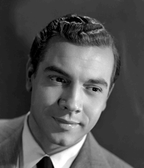
Armando Cesari argues that, "In assessing Mario Lanza, the fact that his career took place mainly at MGM, instead of the Metropolitan, should not be the issue."
Instead, Cesari asserts, Lanza "should be judged purely on the evidence he left behind, which contains many recorded performances that will stand comparison with––and often surpass––those of more fortunate singers whose careers have been almost entirely devoted to opera."
Instead, Cesari asserts, Lanza "should be judged purely on the evidence he left behind, which contains many recorded performances that will stand comparison with––and often surpass––those of more fortunate singers whose careers have been almost entirely devoted to opera."

The Lanza Recordings
However, it needs to be said that locating Lanza’s best recordings can be a daunting task. In the first instance, his legacy is a vast one: almost 400 studio and radio recordings, together with numerous alternate takes and unreleased soundtrack recordings, concert recordings, television performances, and a fascinating series of home rehearsals. Among the material known mainly to Lanza aficionados, there are many outstanding recordings, including a 1951 rendition of Jerome Kern's "All the Things You Are"—recorded for Because You're Mine but never used in the film—in which the tenor dispels all notions that his singing was incapable of nuance. This recording can be heard on the 2025 Sepia Records 2-CD set Mario Lanza: Night and Day, a compilation that includes some of Lanza's finest English-language recordings.
However, it needs to be said that locating Lanza’s best recordings can be a daunting task. In the first instance, his legacy is a vast one: almost 400 studio and radio recordings, together with numerous alternate takes and unreleased soundtrack recordings, concert recordings, television performances, and a fascinating series of home rehearsals. Among the material known mainly to Lanza aficionados, there are many outstanding recordings, including a 1951 rendition of Jerome Kern's "All the Things You Are"—recorded for Because You're Mine but never used in the film—in which the tenor dispels all notions that his singing was incapable of nuance. This recording can be heard on the 2025 Sepia Records 2-CD set Mario Lanza: Night and Day, a compilation that includes some of Lanza's finest English-language recordings.
The variety of genres included in Lanza's legacy is astonishing too: popular songs, operatic arias, operetta, show tunes, art songs, religious songs, and Neapolitan, Spanish and Italian songs. [See this essay for commentary on his LPs, together with CD recommendations.] Although, perversely, Lanza’s versatility has often been held against him, it would be difficult to find another singer as convincing in so many different musical forms. As Enrico Caruso, Jr. observed, "Let it not be forgotten that Mario Lanza excelled in both the classical and the light popular repertory, an accomplishment that was beyond even my father’s exceptional talents."
The Lanza Legacy: A Caveat
The Lanza Legacy: A Caveat
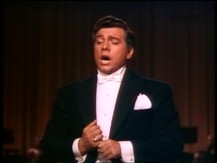
Singing 'Vesti la Giubba' in The Great Caruso
At the same time, it should be acknowledged that Lanza did make some unfathomably bad recordings. By far the worst of these is the 1956 album Lanza on Broadway, which, as Armando Cesari observes, continues to provide incalculable ammunition for the tenor’s many detractors. Some of Lanza's 1959 recordings—although never descending to the depths of the Broadway LP—should also be avoided. [For further reading on Lanza's final recordings, see this essay.]
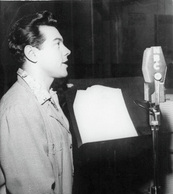
Recording one of his radio shows, 1952
Lanza's 1951-52 Coca-Cola-sponsored radio show is the other main source of substandard recordings. Although he recorded many superb renditions of English songs for these shows—including "Without a Song," "If I Loved You," "Some Day," "I'll Be Seeing You," and "Begin the Beguine"—Lanza's singing of operatic arias and Neapolitan songs, in particular, on these programs often left much to be desired. Sloppy, mannered, and generally wildly over the top, this is the Lanza whom critics delight in attacking.
What the tenor's legion of detractors overlook, however, is that despite its over-representation on CD compilations, the "Coke" material represents a mere eleven-month period in Lanza's life when his career was, in many respects, at its most chaotic. It should also be remembered that these shows were never intended for posterity, and that rehearsal time was often minimal at best.
What the tenor's legion of detractors overlook, however, is that despite its over-representation on CD compilations, the "Coke" material represents a mere eleven-month period in Lanza's life when his career was, in many respects, at its most chaotic. It should also be remembered that these shows were never intended for posterity, and that rehearsal time was often minimal at best.
Most of Lanza's radio renditions of arias and Neapolitan songs—and also a fair number of the English songs—are not representative of the standards he had already achieved either on his film soundtracks or in the RCA studios, and, indeed, would often go on to surpass in the latter part of his brief career. By posthumously releasing so many inferior radio performances, SonyBMG has not helped the tenor’s critical rehabilitation.
The Great Operatic Recordings
But no one—save the most diehard of Lanza's detractors—can overlook the many great recordings of his legacy. Scattered willy-nilly across several BMG/Sony CDs (Mario Lanza: Opera Arias and Duets; the hard-to-find but excellent Mario Lanza: Encore!; the BMG UK "twofer" Serenade/A Cavalcade of Show Tunes), Lanza's outstanding operatic recordings include his 1949 "Che Gelida Manina," his 1950 rendition of "E Lucevan le Stelle," a near-flawless "M’Apparì," the Improvviso from Andrea Chénier, "Dio! Mi Potevi Scagliar" and the Otello Monologue and Death Scene from Otello, and the 1955 version of "Amor Ti Vieta" from Fedora. There are also several poignant renditions of "Vesti la Giubba" from Pagliacci, including a 1948 concert performance and the 1958 soundtrack recording from For the First Time.
The Great Operatic Recordings
But no one—save the most diehard of Lanza's detractors—can overlook the many great recordings of his legacy. Scattered willy-nilly across several BMG/Sony CDs (Mario Lanza: Opera Arias and Duets; the hard-to-find but excellent Mario Lanza: Encore!; the BMG UK "twofer" Serenade/A Cavalcade of Show Tunes), Lanza's outstanding operatic recordings include his 1949 "Che Gelida Manina," his 1950 rendition of "E Lucevan le Stelle," a near-flawless "M’Apparì," the Improvviso from Andrea Chénier, "Dio! Mi Potevi Scagliar" and the Otello Monologue and Death Scene from Otello, and the 1955 version of "Amor Ti Vieta" from Fedora. There are also several poignant renditions of "Vesti la Giubba" from Pagliacci, including a 1948 concert performance and the 1958 soundtrack recording from For the First Time.
In addition, there are fine renditions of the Lamento di Federico ("È la Solita Storia") from L'Arlesiana, "Recondita Armonia" from Tosca, "O Tu Che in Seno agli'Angeli" from La Forza del Destino, the duet "È il Sol dell'Anima" from Rigoletto, the Addio alla Madre from Cavalleria Rusticana, and "Testa Adorata" from Leoncavallo’s seldom-heard La Bohème. Many of Lanza's finest operatic recordings and live performances can be heard on the 2015 Sepia Records release Mario Lanza: Greatest Operatic Recordings and its follow-up disc, Greatest Operatic Recordings, Vol. 2. (Full details about these two CDs are available in our "News" section here and here.) The 2024 Sepia Records CD, Mario Lanza: Golden Days and its follow-up, the 2025 Night and Day, also feature a large number of Lanza's finest operatic recordings---and in stunningly realistic Digitally Extracted Stereo for the first time.
Lanza in Song
Lanza in Song
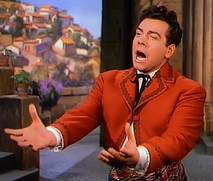
Singing the Addio alla Madre in Because You're Mine, 1952
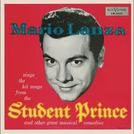
Among his lighter repertoire, Lanza's MGM recording of The Student Prince features some of his most poetic, lyrical singing. Recorded in 1952-53, with Lanza at his vocal peak, highlights include the Romberg "Serenade," "Beloved" (arguably Lanza's finest English-language recording), and "I’ll Walk With God." The best audio reproduction of this album in its entirety can be heard on the 2026 Sepia Records CD Mario Lanza: The Definitive Student Prince. Lanza's evocative rendition of the "Song of India," an adaptation of the "Song of the Indian Guest" from Rimsky-Korsakov's opera Sadko, is another outstanding English-language recording.
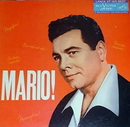
Lanza also excelled in Neapolitan songs. His 1958 album Mario! showcases much of his best singing in this genre, and includes outstanding renditions of the songs "Voce ’e Notte," "Passione," "'Na Sera 'e Maggio," "Tu ca Nun Chiagne" and "Canta Pe’ Me." On CD this album is best heard in its entirety on the 2006 SACD (Super Audio Compact Disc) release Mario! Lanza At His Best. (An alternative choice on CD is Sepia Records' Mario Lanza: My Italian Soul, which includes the highlights from Mario!, in addition to the best of Lanza's remaining Italian and Neapolitan recordings.) Arguably Lanza’s finest concept album, its respected conductor, the Academy of Santa Cecilia’s Franco Ferrara, later hailed the tenor’s "great musicality," further describing him as "vocally extraordinary with a voice that combined steel with warmth . . . a Caruso-type voice."
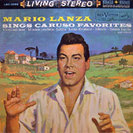
There are also a large number of good recordings, including the poignant 1959 album Mario Lanza Sings Caruso Favorites—sung in what Lanza aficionado Lindsay Perigo accurately describes as the tenor’s "most haunting ethereal voice"—and the delightful Christmas compilation O Holy Night. Perhaps the best introductory CD to Lanza is the aforementioned 2024 Mario Lanza: Golden Days, which brings together the tenor's biggest hits as well as a generous sampling of his finest singing in multiple genres. The 2-CD follow-up set to Golden Days, the 2025 Night and Day, also includes many of Lanza's finest recordings of English-language love songs and operetta, together with some fascinating live and operatic material.
Lanza also excelled in Neapolitan songs. His 1958 album Mario! showcases much of his best singing in this genre, and includes outstanding renditions of the songs "Voce ’e Notte," "Passione," "'Na Sera 'e Maggio," "Tu ca Nun Chiagne" and "Canta Pe’ Me." On CD this album is best heard in its entirety on the 2006 SACD (Super Audio Compact Disc) release Mario! Lanza At His Best. (An alternative choice on CD is Sepia Records' Mario Lanza: My Italian Soul, which includes the highlights from Mario!, in addition to the best of Lanza's remaining Italian and Neapolitan recordings.) Arguably Lanza’s finest concept album, its respected conductor, the Academy of Santa Cecilia’s Franco Ferrara, later hailed the tenor’s "great musicality," further describing him as "vocally extraordinary with a voice that combined steel with warmth . . . a Caruso-type voice."
There are also a large number of good recordings, including the poignant 1959 album Mario Lanza Sings Caruso Favorites—sung in what Lanza aficionado Lindsay Perigo accurately describes as the tenor’s "most haunting ethereal voice"—and the delightful Christmas compilation O Holy Night. Perhaps the best introductory CD to Lanza is the aforementioned 2024 Mario Lanza: Golden Days, which brings together the tenor's biggest hits as well as a generous sampling of his finest singing in multiple genres. The 2-CD follow-up set to Golden Days, the 2025 Night and Day, also includes many of Lanza's finest recordings of English-language love songs and operetta, together with some fascinating live and operatic material.


Lanza's Credo--and a Prophetic Statement
In short, it is a legacy peppered with glorious moments. An uneven legacy, to be sure, but one that overflows with passion, romance, and excitement. While those who demand stylistic perfection and an infallible sense of pitch from their singers will inevitably be disappointed by Lanza, they would do well to note the tenor’s musical philosophy: "I sing each word as though it were my last on earth." In essence, that credo is the key to the tenor’s enduring appeal.
In short, it is a legacy peppered with glorious moments. An uneven legacy, to be sure, but one that overflows with passion, romance, and excitement. While those who demand stylistic perfection and an infallible sense of pitch from their singers will inevitably be disappointed by Lanza, they would do well to note the tenor’s musical philosophy: "I sing each word as though it were my last on earth." In essence, that credo is the key to the tenor’s enduring appeal.
His contemporary Oreste Kirkop knew it. "Only a great heart can sing the way that Lanza sang," the Maltese tenor once observed, echoing the words of Lawrence Tibbett, who had earlier hailed Lanza's "natural zest and unbelievable diction." Although the longhairs have panned him as "a movie singer," Tibbett publicly declared in 1950, Lanza is "the greatest musical talent of America in our century. A man who is bringing great music to the kids, the farms, the ghettos, and the palaces." In 50 years, he concluded, "people will recognize Lanza for the great artist he is."
Many of today’s listeners—untainted by the prejudices of an earlier generation—may well agree.
Many of today’s listeners—untainted by the prejudices of an earlier generation—may well agree.
©Derek McGovern, 2026
References
Caruso, Enrico Jr. and Andrew Farkas. Enrico Caruso – My Father and My Family. New York: Amadeus, 1990.
Cesari, Armando. Mario Lanza: An American Tragedy. Fort Worth: Baskerville, 2004.
Fogel, Henry. Fanfare. November 1987 and January 1990 editions.
Recommended Lanza Biographies
In my admittedly biased opinion, Armando Cesari's Mario Lanza: An American Tragedy (Baskerville, 2008 edition) is the definitive Lanza biography. For more information on this book, click here. Of the remaining Lanza biographies, The Mario Lanza Story by Constantine Callinicos and Ray Robinson (Coward & McCann, 1960) – though often inaccurate and self-serving – is intermittently interesting, and Mario Lanza: Singing to the Gods by Derek Mannering (Mississippi UP, 2005) is a straightforward account of Lanza's life. These and other English-language biographies are discussed in detail on our forum here.
While not a biography as such, Mannering's Mario Lanza: A Life in Pictures (Robert Hale, 2004; reprinted 2015) is a handsome collection of Lanza photographs. Also recommended is Lindsay Perigo's 2016 collection of celebratory essays, interviews and reviews, The One Tenor: A Salute to Mario Lanza.
Documentaries and live performances
Mario Lanza: The American Caruso (1983 Domingo-hosted documentary; available on DVD & VHS)
Singing to the Gods (BBC, 2005) – see under "Lanza Movies" above
Mario Lanza: The Best of Everything (Screenbound, 2017). An excellent documentary featuring incisive commentary from tenor Joseph Calleja and soprano Lesley Garrett, among others. Available in Blu-Ray.
Mario Lanza: Bringing Opera to the Masses (Sky, 2018) Some peculiar errors (e.g. a commentator's reference to "Ernesto" Caruso) aside, and the occasionally odd choice of musical selections, this is a balanced and well-made documentary. Currently available here on YouTube.
Caruso, Enrico Jr. and Andrew Farkas. Enrico Caruso – My Father and My Family. New York: Amadeus, 1990.
Cesari, Armando. Mario Lanza: An American Tragedy. Fort Worth: Baskerville, 2004.
Fogel, Henry. Fanfare. November 1987 and January 1990 editions.
Recommended Lanza Biographies
In my admittedly biased opinion, Armando Cesari's Mario Lanza: An American Tragedy (Baskerville, 2008 edition) is the definitive Lanza biography. For more information on this book, click here. Of the remaining Lanza biographies, The Mario Lanza Story by Constantine Callinicos and Ray Robinson (Coward & McCann, 1960) – though often inaccurate and self-serving – is intermittently interesting, and Mario Lanza: Singing to the Gods by Derek Mannering (Mississippi UP, 2005) is a straightforward account of Lanza's life. These and other English-language biographies are discussed in detail on our forum here.
While not a biography as such, Mannering's Mario Lanza: A Life in Pictures (Robert Hale, 2004; reprinted 2015) is a handsome collection of Lanza photographs. Also recommended is Lindsay Perigo's 2016 collection of celebratory essays, interviews and reviews, The One Tenor: A Salute to Mario Lanza.
Documentaries and live performances
Mario Lanza: The American Caruso (1983 Domingo-hosted documentary; available on DVD & VHS)
Singing to the Gods (BBC, 2005) – see under "Lanza Movies" above
Mario Lanza: The Best of Everything (Screenbound, 2017). An excellent documentary featuring incisive commentary from tenor Joseph Calleja and soprano Lesley Garrett, among others. Available in Blu-Ray.
Mario Lanza: Bringing Opera to the Masses (Sky, 2018) Some peculiar errors (e.g. a commentator's reference to "Ernesto" Caruso) aside, and the occasionally odd choice of musical selections, this is a balanced and well-made documentary. Currently available here on YouTube.
Recommended Videos, DVDs, and Blu-Rays
Lanza movies:
The Great Caruso (1951) Blu-ray (information here). The Blu-ray version, unlike the DVD release, also contains Mark Kidel's 2005 BBC documentary Singing to the Gods.
Because You're Mine (1952) DVD
The Student Prince (1954)--voice only, beautifully reproduced on this 2011 DVD
Serenade (1956) DVD, also a Spanish blu-ray (information here)
That Midnight Kiss/The Toast of New Orleans (Double DVD – Warner Bros. 2007). (This also contains Mark Kidel's 2005 BBC documentary Singing to the Gods.)
Please note: A splendid official blu-ray of That Midnight Kiss was released by Warners in 2025, followed by an equally good Blu-ray version of
For the First Time (1959) in 2026.
Lanza movies:
The Great Caruso (1951) Blu-ray (information here). The Blu-ray version, unlike the DVD release, also contains Mark Kidel's 2005 BBC documentary Singing to the Gods.
Because You're Mine (1952) DVD
The Student Prince (1954)--voice only, beautifully reproduced on this 2011 DVD
Serenade (1956) DVD, also a Spanish blu-ray (information here)
That Midnight Kiss/The Toast of New Orleans (Double DVD – Warner Bros. 2007). (This also contains Mark Kidel's 2005 BBC documentary Singing to the Gods.)
Please note: A splendid official blu-ray of That Midnight Kiss was released by Warners in 2025, followed by an equally good Blu-ray version of
For the First Time (1959) in 2026.