
1945
Myths about Mario Lanza: the Man
by Derek McGovern
Myths about Mario Lanza: the Man
by Derek McGovern
Mario Lanza was once described by an RCA liner notes writer as having had the "cosmic misfortune" of possessing the personality of a devil coupled with the voice of an angel. Yet to others, such as his Rome publicity agent, Sam Steinman, Lanza may have had his fair share of flaws, but he was "more sinned against than sinner." This has not stopped tabloid writers and even several biographers from feasting on the man's misdeeds and excesses, both real and imagined.
But for every allegation that Lanza was an impossibly crude, out-of-control sybarite or an insufferable egotist, there is ample testimony emphasizing a very different person.

To several young sopranos who worked closely with Lanza, for example, he behaved impeccably. The New York City Opera's Elaine Malbin found him "very sweet and very charming" when they recorded duets together from La Traviata and Madama Butterfly in April 1950. To Gloria Boh, with whom he recorded the Act III duet from Verdi's Otello five years later, Lanza was down to earth and "really a nice guy." She added that, "Meeting him for the first time was just like meeting a member of your own family." Lanza's co-star in The Great Caruso, Ann Blyth, although aware of stories regarding his temperament, found the tenor a similarly pleasant colleague: "We got on quite, quite well and it was a thoroughly delightful shoot." Lanza's many acts of kindness towards Raphaela Fasano, a young girl dying from Hodgkin's Disease, have also been well documented.
This essay—an extension of our forum discussion "Lanza the Person"—addresses four of the most frequently regurgitated myths about the man. (Rumors about Lanza's voice, training, and musical ability are challenged in the article Myths about Mario Lanza, the Artist.)

At home in 1952
Fact
Lanza was clearly no saint, as he freely acknowledged, but the assessments of dozens of individuals who were close to him throughout his life invariably underscore his fundamental warmth and decency. Let's therefore examine each of the statements that comprise Milazzo's "monster" allegation.
Eating and drinking. It is true that Lanza was capable of gaining extraordinary amounts of weight from binge-eating (although why this should invite derision instead of sympathy escapes this writer). It is equally true that during happy, productive periods of his life (such as the latter half of the 1940s) his weight remained stable and non-problematic for his height and build. However, like many highly emotional and sensitive individuals, Lanza frequently sort refuge in food during times of emotional crisis. At the same time, he was equally capable of losing staggering amounts of weight (often in a dangerously short period) when asked to do so by managers and film producers. One need only compare the photo (below, left) of an overweight Lanza in Naples in May 1957 with that of the much slimmer man less than seven weeks later on his return to that city (below, right) for an example of dramatic weight loss.

May 28, 1957

July 14, 1957
There is also testimony from many of Lanza's friends, including George London and Sam Steinman, that he developed a serious drinking problem in his early 30s. Whether he was technically an alcoholic in the last five or so years of his life has been hotly debated, but there can be no doubt that he was, at the very least, an episodic or binge drinker, and that his health and some of his personal relationships were negatively affected by his drinking. According to Steinman, the problem was further complicated by Lanza's low tolerance for alcohol. Immensely strong, the tenor was also extremely difficult to control when intoxicated.
However, the extent to which he drank has been exaggerated. Lanza may have indulged in alcoholic binges during times of emotional crisis, but he was usually able to control his drinking when he was working. In the penultimate year of his life, for example, he demonstrated that he was still able to function successfully as a live performer, giving 22 recitals on a (mostly) critically well-received European tour. Moreover, at no time was Lanza ever accused of performing while intoxicated. That same year (1958), no problems were reported on the set of his final film, For the First Time, and by all accounts Lanza's fellow cast members found him a warm and cooperative colleague. In short, portrayals of the tenor as a hopeless drunk do not bear close scrutiny.
Womanizing. The principal sources of the tales of Lanza’s supposedly rampant womanizing are his friend Terry Robinson (in a lowbrow biography of the tenor co-authored by Raymond Strait) and his one-time manager Al Teitelbaum, a convicted fraudster and author of a tabloid-style biography published in 1971 under the pseudonym “Matt Bernard.” (Robinson and Teitelbaum were also primary sources for Roland Bessette's negative portrayal of Lanza in his 1999 biography.) Their lurid tales—all of which (rather tellingly) involved either unnamed or deceased women—are contradicted, however, by several individuals who worked closely with Lanza, including Callinicos, Steinman, and conductor Paul Baron (interviewed by this writer in 1982). While all three were critical—often harshly so—of other aspects of Lanza's behavior, they were adamant that the tenor was not a womanizer. Lanza may have been unfaithful to his wife on rare occasions, but it is difficult to imagine how he could have habitually "pursued women as . . . prey" without these men being aware of the fact. Indeed, Steinman even recalled it being the other way round: "I can tell you that if [Lanza] was cornered [by a woman], he would get into a cold sweat and I or – even more than I – [actor] Alex Revides had to bail him out."
Relationships with colleagues. Lanza’s name may have been a “curse word” among the MGM executives with whom the tenor clashed during the initial filming of Because You’re Mine (1952)—a film that he considered (with some justification) an unworthy follow-up to The Great Caruso—and, later, during the pre-production period of The Student Prince, but many of his co-stars, including Keenan Wynn, James Whitmore, Sarita Montiel, Johanna Von Koczian and Ann Blyth, found him a friendly and unpretentious colleague. (Indeed, decades after the tenor's death, Ms. Blyth expressed how much she had "looked forward to working with him again" on The Student Prince.) MGM Musical Director John Green, with whom Lanza worked on three films, later recalled: “I was very fond of him. He was capable of such warmth, and he had a nice sense of humor. You could have great fun with Mario.”

Lanza with James Whitmore, 1951
Kathryn Grayson, on the other hand, publicly criticized the tenor on at least one occasion, telling reporters in 1952 that she "couldn't stand the man," and implying that his language was objectionable on the sets of their two films together. Lanza never responded publicly to her criticisms, and Grayson later told the press that she had regretted airing her "animosities in public."
Temperament and character. Vincent Price, who worked with Lanza on the film Serenade in 1955, found the tenor quite unlike the temperamental star depicted in the press. He also defended Lanza from accusations of egotism: "Mario doesn’t have a big ego. He is a man who happens to own one of the greatest voices of our time. For him to pretend he is unaware of this would be foolish and unbelievable. There’s a big difference between being aware of your talent and being an egotist, believe me!" Gisèle MacKenzie, a regular performer on Lanza's 1951-52 radio show, took a slightly different view, but also defended the tenor: "He has a great talent, so naturally he’s bound to have the ego that goes with it." She added: "Every singer in every field has to have an ego, or he wouldn't have the nerve to do his work." In any event, she concluded, "I’ve met lesser stars who aren’t half so kind and considerate." In her 2013 autobiography, A Memoir, Rita Moreno describes Lanza as "wild, woolly and mischievous" on the set of The Toast of New Orleans (1950), adding that she "couldn't help but like him" (p. 94).
To the Metropolitan Opera soprano Licia Albanese, with whom Lanza also worked closely in Serenade, the tenor "was not a complicated man. He had a great voice and a big soul. He was marvelous company, and he was a gentle man." Moreover, these were not aspects of Lanza's personality reserved for his friendships with the famous. As Antonio Fabianelli, his janitor in Rome for over two years, recalled: "I never felt as if he was my employer. He treated me as his equal, like a brother. He was kind, warm and considerate, and his tragic death was a personal loss to me."
Note: The sources for many of the quotes in this section are interviews by Armando Cesari conducted between 1977 and 1980. See his Mario Lanza: An American Tragedy (2nd ed. Baskerville, 2008.)
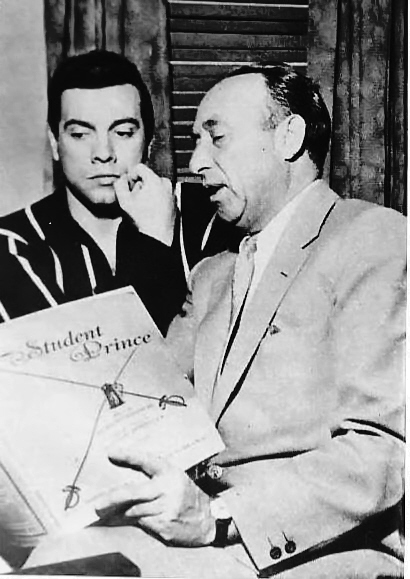
Lanza in 1952 with producer Joe Pasternak during pre-production on The Student Prince
Fact
Lanza's weight was never a major factor in his non-appearance in The Student Prince, and in fact he was slim throughout the pre-production period, as photos taken at the time reveal.
The genesis of the problems that led to Lanza's non-appearance in the film can instead be traced back to the creative disagreements that he had with director Curtis Bernhardt during the pre-recording of The Student Prince score in July 1952. Bernhardt reportedly took issue with Lanza over the latter's interpretation of one of the songs (“Beloved”), and relations between the two quickly deteriorated. Finding himself unable to work with Bernhardt, Lanza embarked on a protracted battle with Studio Head Dore Schary. The latter, who made no secret of his disdain for film musicals—and who had earlier opposed the making of Lanza's enormously popular The Great Caruso (ironically on the grounds that it would be financially unsuccessful)—had clashed the previous year with the tenor over Because You're Mine. Schary refused to replace Bernhardt, and ultimately fired Lanza. Ironically, MGM eventually made The Student Prince with The Great Caruso's Richard Thorpe—the very director whom Lanza had requested (to no avail) as the ideal replacement for Bernhardt.
In an interview with Armando Cesari, the actor Stewart Granger, who knew and liked Lanza, put the tenor's troubled relationship with Bernhardt and Schary into perspective:
Mario was inexperienced about the goings-on of the studios and the making of films. As such he took it to heart if he felt betrayed or was unjustly treated by someone like Schary, who was the total opposite of a fatherly figure like [Louis B.] Mayer [the previous head of MGM, and a man with whom Lanza had enjoyed a pleasant working relationship].

Stewart Granger
You needed to have a thick skin to deal with these people and Mario didn’t have one; he was totally open and therefore completely vulnerable.

Curtis Bernhardt in 1954

London, November 1957
Fact
One only needs to listen to Lanza in unscripted interviews (some of which can be heard in our Multimedia section) to ascertain that he was both articulate and intelligent, qualities also frequently mentioned by his friends and colleagues.
MGM Musical Director John Green: “I found it fascinating, musically, to work with Mario. He had a sensational ear, and he was bright . . . Mario was not stupid at all!” Metropolitan Opera soprano Licia Albanese, who worked closely with Lanza in 1955, singled out the tenor's intelligence in this 1995 interview. Screenwriter Andrew Solt, who worked with Lanza on his final film, concurred: “[He was] highly intelligent, very smart, and fast and funny.” [Source here]

Singing in Naples, July 1957
Fact
Lanza’s demise had nothing to do with the Mafia, nor is there any proof that the tenor was scheduled to sing in Naples near the time of his death.
The sole source of the latter rumor was journalist Mike Stern, who in a sensationalized and often self-serving account of Lanza's final two years claimed that the tenor had let him down at the last minute in September 1959 by reneging on a promise to participate in a NATO charity concert in Naples (Stern, An American in Rome, 1964, p.294). However, nowhere in his book, nor in a subsequent television interview, does Stern mention anything about Mafia involvement in the concert.
Stern's account, in any event, is dubious for several reasons. Firstly, it seems improbable that Lanza, who had not sung in public for seventeen months, would have agreed to return to live performing when he had only recently recovered from a serious bout of double pneumonia. Moreover, he was very overweight at the time, and would surely have been aware that he was in no condition to be performing in public. (Indeed, he was about to undergo the potentially dangerous "twilight sleep" treatment in order to lose a substantial amount of weight for an upcoming movie.) It also seems highly unlikely that Lanza, who would have been making his first billed singing appearance in Italy at the supposed concert, would have agreed to share the program with numerous entertainers in what hardly promised to be a prestigious affair.


Note: In a 1977 interview with Armando Cesari conducted while Stern was still alive, Sam Steinman dismissed the latter's published reminiscences on the tenor as "mostly made up." Steinman also recalled that Lanza had twice rebuffed Stern's journalistic proposals. Stern had wanted to write a book about the tenor, but the latter declined to cooperate with him; on another occasion, Lanza "more or less threw [him] out" when he sought to replace Steinman as his publicity agent, telling him: "I don't like your way of doing things."
In their 1980 book, Robinson and Strait appear to confuse Stern's account of the supposed NATO concert with a Mafia-backed event in Naples that actually did occur—albeit two years earlier. In July 1957, Lanza had been invited to Naples to receive the Enrico Caruso Award from Caruso's youngest son. The tenor was pressured into singing at the event, which by now he had learned to his dismay was a massive political rally in disguise supported by local Mafia boss Luigi Campolongo. (See A Mario Lanza Scrapbook for further information.) Given Lanza's resentment at being used as a pawn by the Mafia at this event, he would hardly have agreed to return to Naples two years later at the behest of the same criminal organization. Moreover, Lanza detested the Mafia, having (apparently) witnessed as a child one of his father's brothers (Uncle "Scabby") being murdered in Philadelphia by a local mobster.
Without providing any sources, Robinson and Strait also claim that Mafia boss Lucky Luciano was a regular and uninvited guest at Lanza's villa in Rome, and that it was he who orchestrated the supposed concert in Naples in September 1959. However, they fail to explain how such an easily recognizable and notorious gangster who had been banned for life from entering Rome could have visited the tenor so openly in that same city. (According to the Rome News-Tribune and various biographers, Luciano was also under constant police surveillance in Italy during this period.) In fact, there is no evidence that Lanza and Luciano even met.
Robinson's subsequent claim on the 1983 PBS documentary Mario Lanza: The American Caruso that the tenor's nurse and chauffeur had mysteriously disappeared after his death is based on the flimsiest of evidence, namely, that the Lanza family, on their return to the United States, never heard from either employee again. But then, why would they? Betty Lanza, their remaining employer, died only five months after her husband, and the nurse and chauffeur would hardly have remained in contact with the Lanzas' four young children, none of whom was even in their teens at the time (and living a continent away).
Equally unconvincing are Bacon's dark intimations of foul play on the same documentary. Bacon speculates that air was pumped into the tenor's veins to simulate a heart attack. He also claims that heavyweight boxing champion Rocky Marciano told him that the tenor could not have died of a heart attack (as was reported at the time) because "Rocky used to work out with him all the time" and had marveled at his friend's extraordinarily strong heart.
This argument is obviously nonsensical. Marciano was not a medical professional, and was certainly never privy to the tenor's cardiograms—nor was he even in Italy when the latter was living there. (Neither, for that matter, were Robinson, Strait, and Bacon.)


In reality, Lanza was in poor health at the time of his death, and had been suffering from a variety of diagnosed ailments for the previous twenty-one months. These included abnormally high blood pressure, liver damage, arteriosclerosis, and phlebitis. Although an autopsy was not performed on his body, the cause of death was almost certainly one of the following: a heart attack, a cerebral hemorrhage, or a massive pulmonary embolism. See Mario Lanza: A Fatal Zest for Living, by Armando Cesari and Prof. Philip A. Mackowiak, MD, for further information.